
Machine basics · 7 min read
How an industrial sweeper works
Four parts do all the work, and one of them — the filter — is responsible for most complaints about a sweeper that has stopped picking up.
The main brush throws, it does not scoop
A cylindrical main brush spins toward the hopper, flicking material up and over its own axis. It is a throwing action, not a scooping one, which is why brush height matters so much: too high and material passes underneath, too low and the bristles buckle, wear fast and drag power.
Correct contact is a narrow strip of bristle touching the floor — visible as a dark line roughly 40 to 60 mm wide when the machine is lifted. We set this at delivery and check it at every service.
Side brushes handle edges and corners
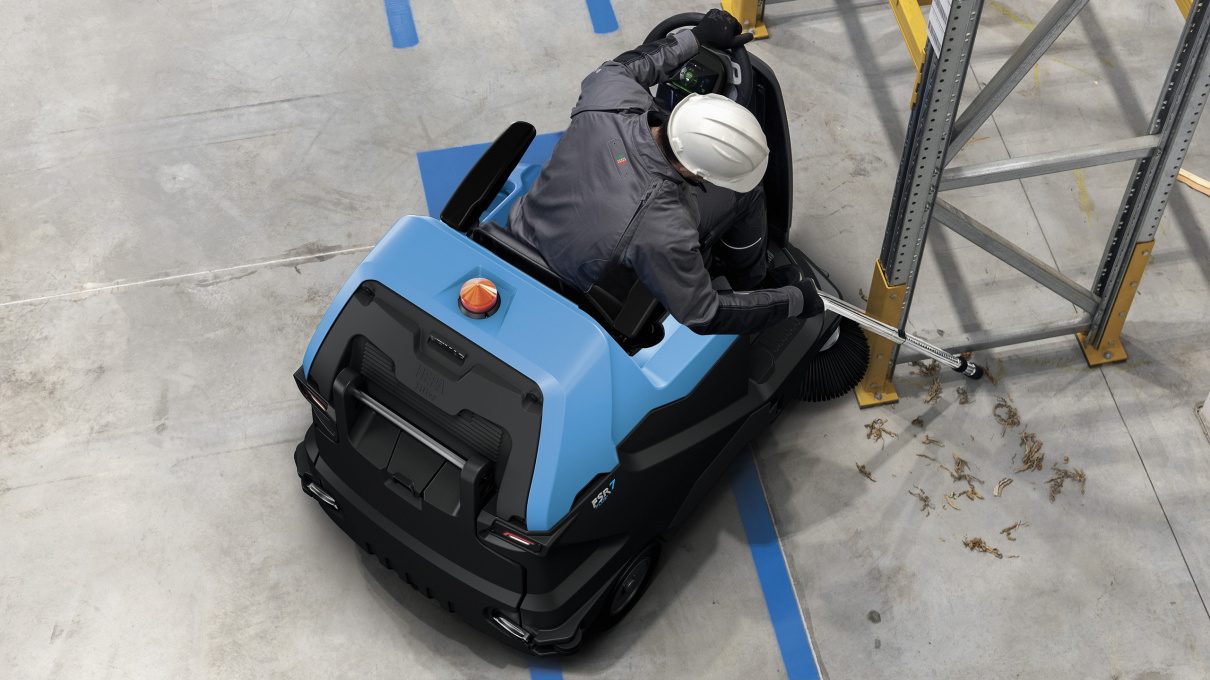
The main brush cannot reach walls, kerbs or racking legs, so angled side brushes sweep material inward into its path. They are consumables and they wear at the tips, which is why a machine that used to clear edges suddenly leaves a debris line — a five-minute fix, not a fault.
Airflow is what controls the dust
Behind the brush, a fan pulls air out of the hopper through a filter, creating negative pressure. That is what keeps fine dust inside the machine rather than becoming a plume behind it. Block the filter and three things happen at once: the dust escapes, the throwing action loses its assisting airflow, and the fan works harder.
So when a sweeper appears to stop picking up, the filter is the first suspect — not the brush. Shake or pulse the filter at the interval the machine specifies, and more frequently in cement, gypsum or flour dust.
For very fine material we fit sock-type filters, which present far more filter area and hold their airflow much longer in heavy dust. This is the single most useful upgrade on cutting, grinding and demolition work.
The hopper decides your run time
Hopper volume, not battery capacity, sets how long you sweep between stops. On heavy debris a small hopper can fill in fifteen minutes, and each emptying costs travel time to the bin. When we size a machine we are really sizing the hopper against the debris load and the distance to your waste point.
| Symptom | Most likely cause | Field check |
|---|---|---|
| Leaves a strip of debris in the middle | Main brush worn or set too high | Look for the contact line; adjust or replace |
| Leaves debris along walls | Side brush tips worn | Compare bristle length to a new brush |
| Visible dust plume behind machine | Filter blocked or seal leaking | Pulse or shake filter, inspect gasket |
| Fills the hopper very fast | Machine undersized for debris load | Move up a class or add a second pass |
| Pick-up drops on fine powder | Panel filter unsuitable | Fit a sock-type filter |